Quick answer
No ship is best for every mission. Build a shortlist from the event's recommended class and tier, the stat that matters to its objective, and whether your settlement can construct, crew, and support the hull now. The official Ships and Events records jointly support that mission-fit approach: path classes specialize in different stats, and event recommendations use class, tier, and relevant stats to establish baseline winning chances.
For an early fleet, timing matters more than owning the largest available hull. A ship that matches the task and is ready to sail is a stronger editorial choice than a higher-tier project that drains crew or remains unfinished. Use the ships primer for hull progression and the ship combat primer for battle mechanics; this page focuses on the decision.
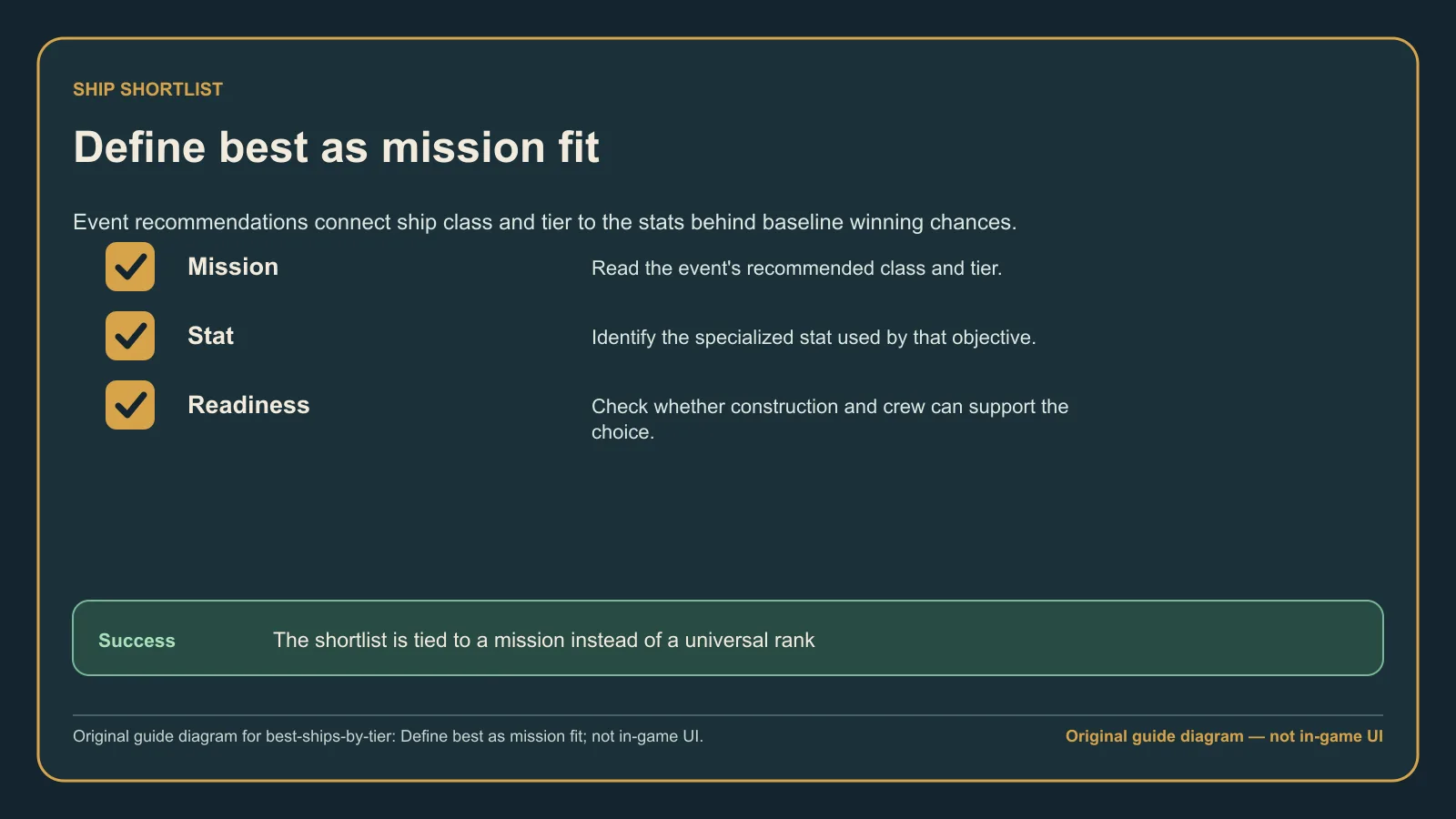
Original guide diagram — not in-game UI. Start with the mission requirement instead of a permanent overall ranking.
Ranking criteria and evidence boundary
Apply these criteria before reading any recommendation:
- Event match — 50%. Does the live event recommend this class and tier?
- Relevant stat — 35%. Does the class specialize in the stat used by the objective?
- Fleet readiness — 15%. Can the settlement build, crew, and support the ship without creating a more urgent problem?
These weights are an editorial model, not an in-game score. They make the trade-off visible and prevent a named hull from being treated as an automatic winner. Exact ship records below come from a single official wiki page and are therefore labeled as version-sensitive examples. Recheck the live ship and event screens after a balance patch.
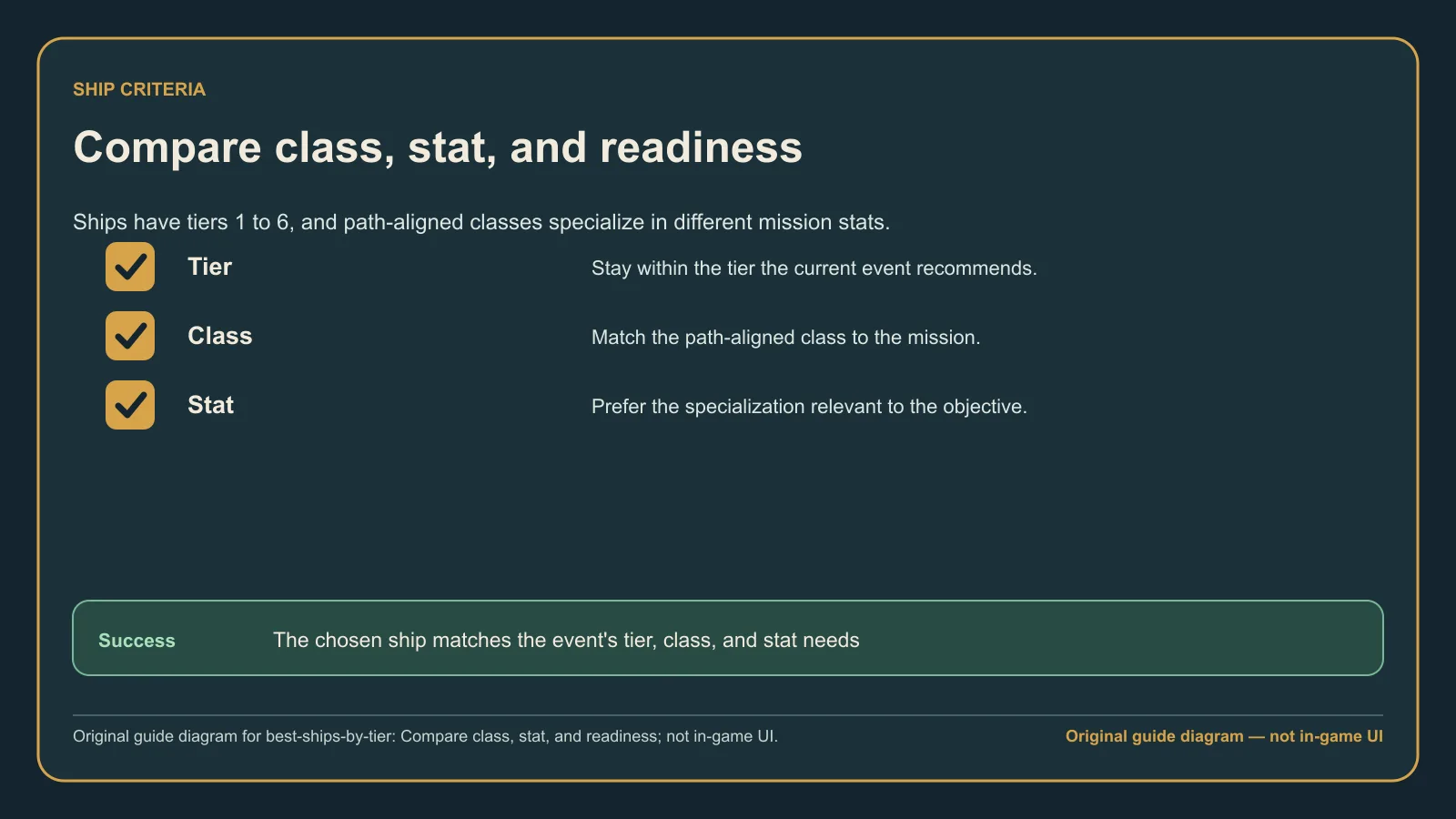
Original guide diagram — not in-game UI. A shortlist only survives this step when every criterion points toward the same mission.
Ships by mission and tier
| Decision point | Mission-fit recommendation | Evidence boundary |
|---|---|---|
| The event names a class and tier | Start with ships that meet both; do not upgrade merely because a higher tier is visible | Official Events and Ships records support class-and-tier matching, not a permanent tier list |
| The objective emphasizes a specialized stat | Prefer the path class tied to that stat, then compare readiness | Class specialization is supported; the final weighting is editorial |
| Two candidates fit the event | Choose the one your current crew and construction plan can support | Readiness is a planning criterion, not an official combat guarantee |
| No candidate fits cleanly | Delay, change the objective, or improve the fleet rather than inventing a universal fallback | The approved evidence does not support a single all-purpose hull |
Bounded Tier 2 examples
- Iron Fist for a Gun Damage and Armour requirement. A version-sensitive official-wiki record identifies Iron Fist as a Tier 2 Empire Destroyer and describes Destroyers as specializing in Gun Damage and Armour. That makes it a reasonable shortlist entry when those are the mission's relevant stats; it does not make Iron Fist superior outside that role.
- Tide Runner for a Speed requirement. A version-sensitive official-wiki record identifies Tide Runner as a Tier 2 Seafaring Hunter and describes Hunters as excelling at Speed. It is a reasonable shortlist entry for a Seafaring task that values Speed, not proof that it is the best Tier 2 ship overall.
The same method applies beyond Tier 2: read the current event, stay within the recommended tier, identify the relevant specialization, and then check whether the fleet can support the choice. The official Ships page currently describes tiers from 1 through 6, but the exact list and balance come from one changing reference, so this guide does not freeze every tier into a permanent winner.
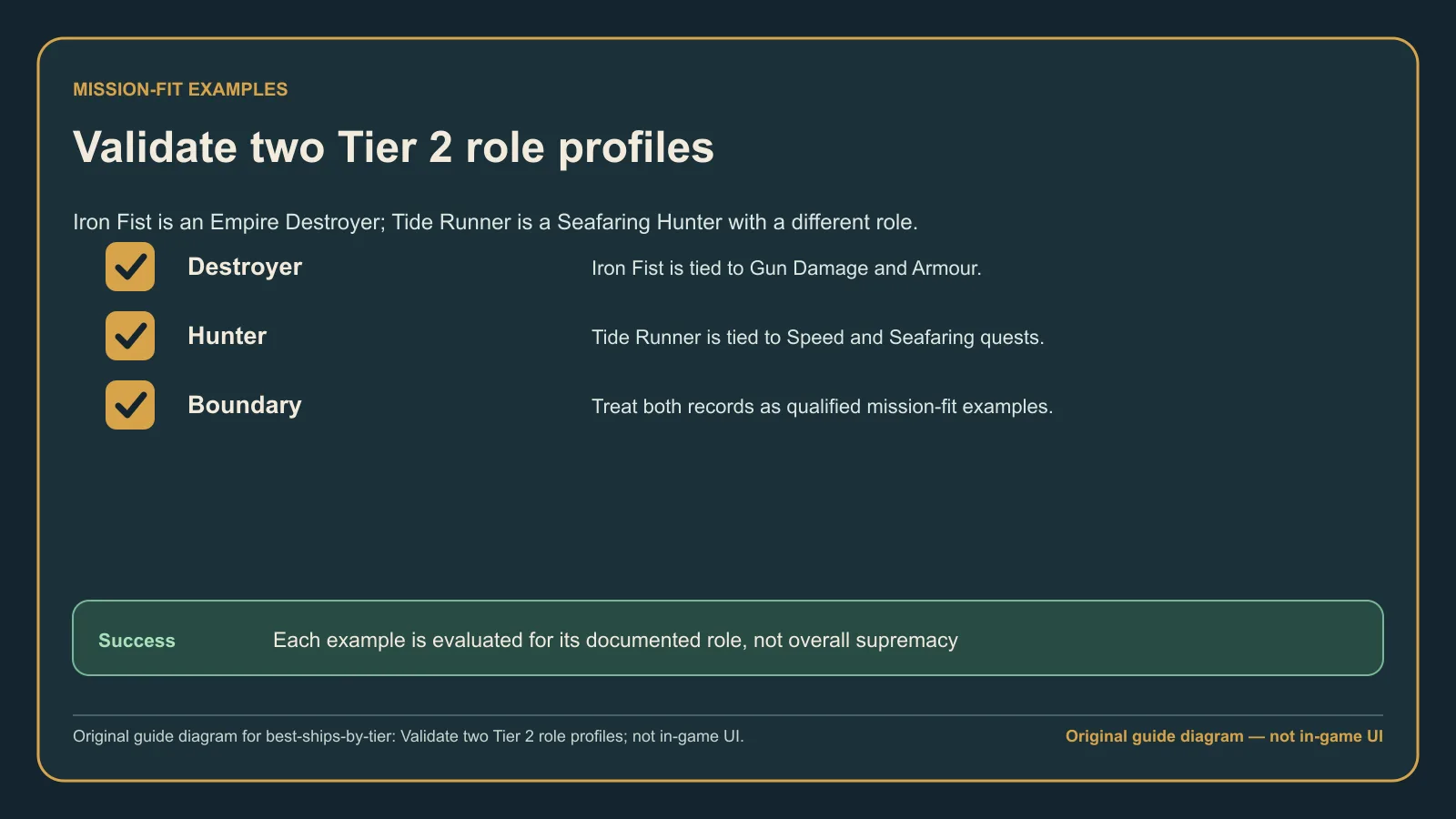
Original guide diagram — not in-game UI. Iron Fist and Tide Runner illustrate different role profiles, not first and second place.
Common mistakes
- Ranking a hull by tier alone while ignoring the event's recommended class.
- Treating a specialized stat as useful for every objective.
- Calling a named Tier 2 example the overall winner after reading only one official ship record.
- Committing construction and crew before checking whether the settlement can support departure.
- Copying a fixed ranking across patches without reviewing ship and event changes.
- Repeating combat mechanics here instead of using the ship combat guide for the underlying system.
FAQ: Frequently asked questions
What is the best early-game ship?
The best early choice is the ready ship that matches the current event's class, tier, and relevant stat. The evidence does not establish one named hull for every early save, so use mission fit and current readiness instead of a fixed answer.
Is a higher-tier ship always better?
Not for the decision this guide answers. The event recommendation and relevant stat come first. A higher tier that misses the role or cannot be supported is not automatically the better mission choice.
Should I choose Iron Fist or Tide Runner?
Choose by task. Iron Fist is the bounded example for Gun Damage and Armour; Tide Runner is the bounded example for Speed. Recheck their current records in game because both examples depend on one version-sensitive official page.
What to do next
- Use the captains tier list to match a passive and Captain Card to the mission you just selected.
- Read the ships primer when the blocker is hull progression, construction, or crew rather than comparison.
- Move to the ship combat guide before a hostile event that requires tactical preparation.