Quick answer
No captain-and-ship combination is best for every event. Read the event's important stats, choose its recommended ship class and tier, then add a captain whose passive and full Captain Card trade-off support that same task. Official event and captain records support two bounded examples: a Crown Port combat profile built around Gun Damage and Armour, and a Chase profile built around Speed and Manoeuvrability.
These are editorial decision aids, not official synergies or guaranteed wins. Use the ships primer for class and hull mechanics, the captains tier list for captain scoring, and the ship combat primer for tactical preparation.
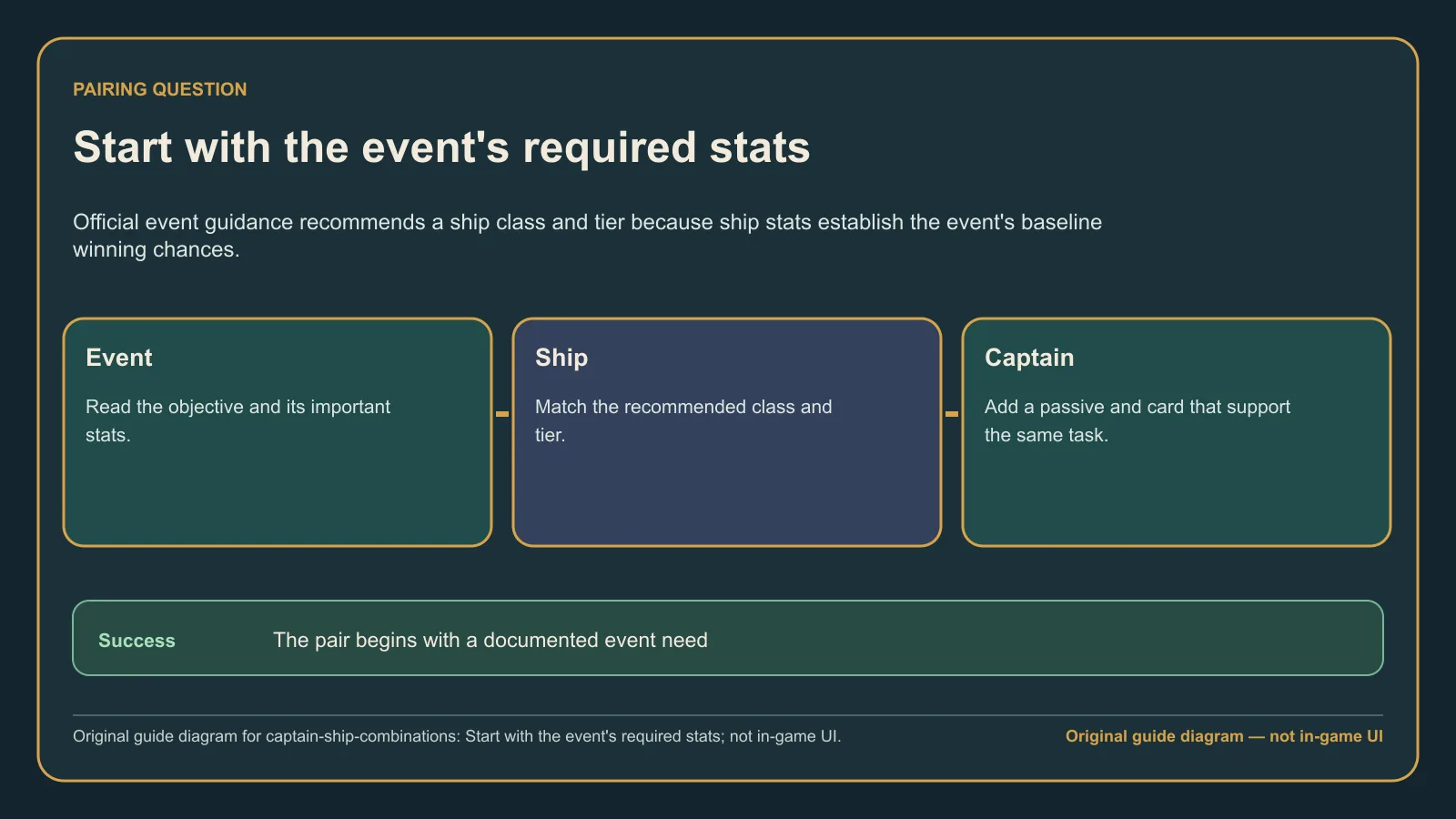
Original guide diagram — not in-game UI. A combination is useful only when both inputs answer the same mission.
Pairing criteria
Apply the criteria before choosing either name:
- Event stats — 45%. Which stats drive the objective described by the event?
- Ship fit — 35%. Does the recommended class and tier specialize in those needs?
- Captain fit — 20%. Does the passive strengthen the same task, and does the Captain Card suit the planned turn without hiding its downside?
This order matters. Adding two highly ranked inputs does not create a good pairing when they answer different objectives. The official Events page currently says events recommend a class and tier because ship stats establish baseline winning chances; that single-page description is version-sensitive and does not promise success.
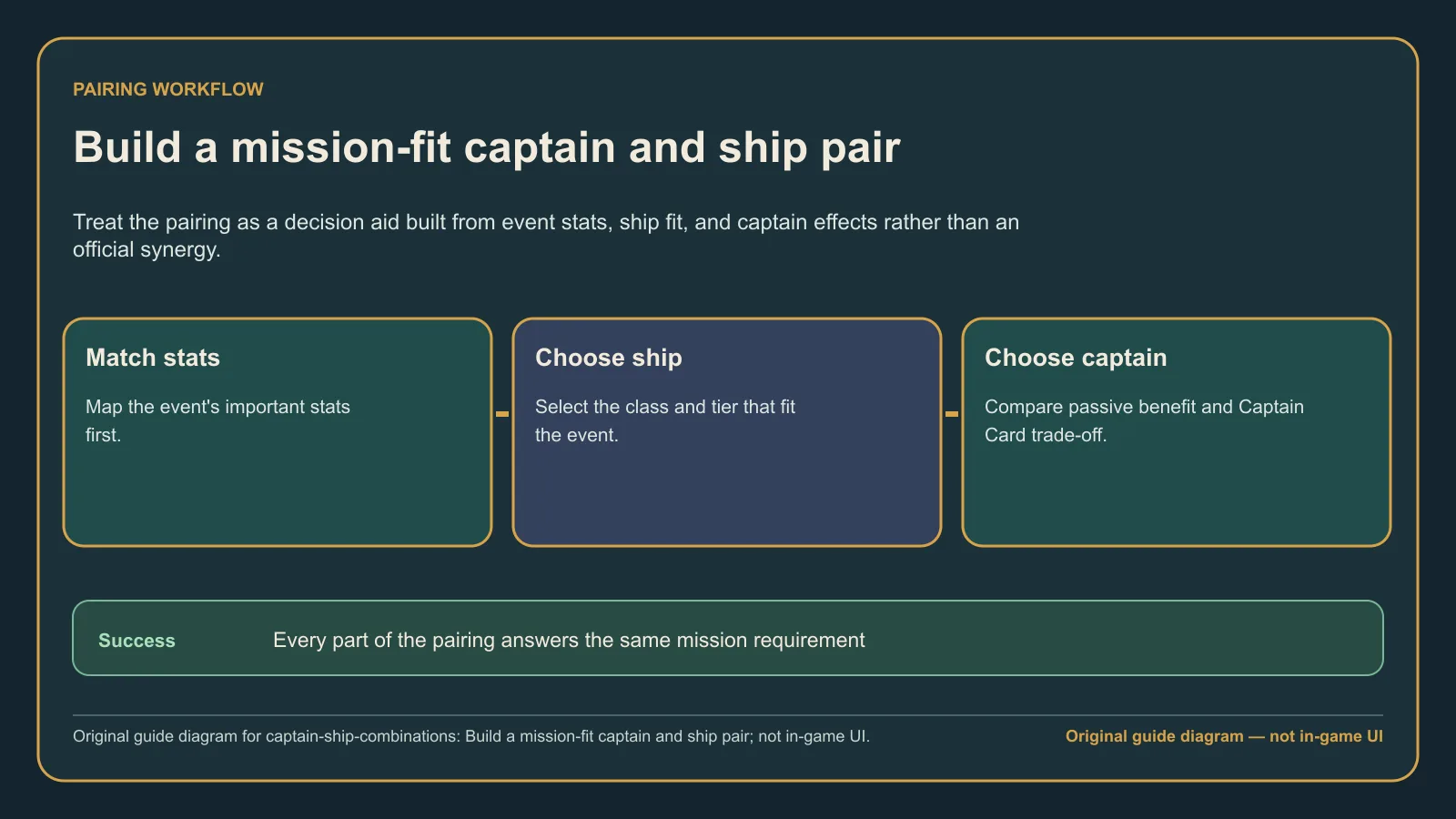
Original guide diagram — not in-game UI. The workflow prevents a captain tier label from replacing the mission analysis.
Mission-fit combinations
| Mission profile | Ship input | Captain input | Why the inputs fit | Boundary |
|---|---|---|---|---|
| Crown Port combat | Tier 2 Destroyer, as recommended by the official event record | Teach | The event record highlights Gun Damage and Armour; the official captain list gives Teach a Gun Damage bonus plus Health and a next-turn die card | A focused combat example, not a guarantee or an all-event winner |
| Chase | A ship selected for Speed and Manoeuvrability | Kanja | The event record uses Speed and Manoeuvrability for distance effects; the captain list gives Kanja a Speed bonus | Kanja's card condition remains relevant and the approved record does not fill any unsupported Manoeuvrability gap |
| Exploration with another stated requirement | The live event's recommended class and tier | A captain whose documented passive serves the same relevant stat | Both choices begin with the live objective | Do not import the Crown Port or Chase pair when the required stats differ |
| Hauling or supply pressure | Read the live task and ship information first | Compare only documented supply-related captain effects | Resource pressure may change what is ready to sail | The approved page facts do not establish a named hauling ship combination, so this guide does not invent one |
Crown Port combat: Destroyer plus Teach
The two-source official record recommends a Tier 2 Destroyer for a Crown Port because Gun Damage and Armour are important. The captain list records Teach with +20% Gun Damage and +20% Health. This pairing has a readable reason: the ship class targets the event's combat profile, while Teach directly supports Gun Damage and adds Health. Inspect his live Captain Card separately because this page's approved pairing record does not establish its value for the Crown Port objective.
Chase: Speed-focused ship plus Kanja
The two-source official record says Chase objectives use Speed and Manoeuvrability for distance-related effects, while Kanja supplies +20% Speed. That is a direct fit for one of the two stated stats. It is not proof that Kanja or the chosen hull supplies every required stat. Her conditional dice card also remains a separate tactical risk, so keep its live wording visible.
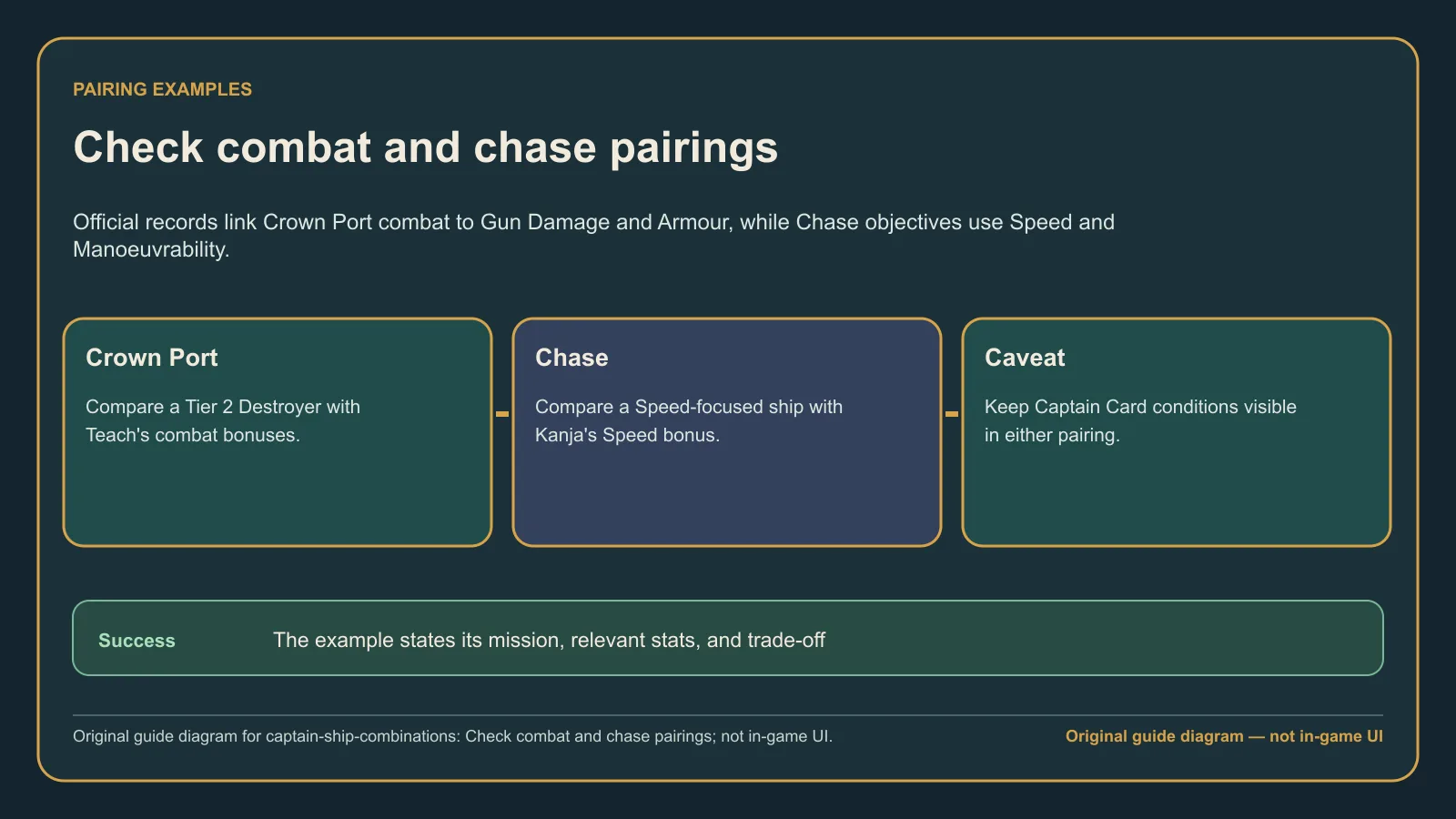
Original guide diagram — not in-game UI. A valid example states what fits and what remains unsupported.
Common mistakes
- Combining an S-tier captain with a high-tier ship without reading the event.
- Assuming a passive that helps one stat covers every stat the objective uses.
- Calling an editorial pairing an official synergy or guaranteed win.
- Hiding a Captain Card condition when describing the recommendation.
- Sending a theoretically good pair before construction, crew, and supplies are ready.
- Publishing a named hauling combination when the approved facts do not document the required ship input.
FAQ: Frequently asked questions
What is the best captain and ship combination?
There is no single best pair across all missions. Start with the live event's important stats, then select a matching ship and captain. The Crown Port and Chase pairs above are bounded examples for different goals.
Why not combine the highest captain tier with the highest ship tier?
Because the criteria measure shared mission fit, not the sum of two labels. A captain passive can support the wrong stat, and a ship can miss the event's recommended class even when both look strong separately.
What should I use for hauling?
The evidence package does not support one named hauling pair. Read the live task, compare ship readiness and required stats, then treat documented supply effects as one input rather than inventing an overall hauling winner.
What to do next
- Use the ship combat guide to prepare the chosen pair for a hostile objective.
- Recheck hull class and tier in the ships primer.
- Re-score the captain's passive and card in the captains tier list.