Quick answer
There is no single item that is always the best to sell. Use a reserve-first decision: protect current upkeep and exclusive-use goods, keep enough input for active production, account for Fetcher and handling pressure, and sell only a genuine surplus through the Trading Post. The official Trading Post and Coins pages both support the basic exchange of stored Resources for Coins.
This guide ranks a sale by reserve safety (40%), listed sale value (35%), hard exclusions such as required or zero-value goods (15%), and other available Coin routes (10%). Those criteria are editorial, not an in-game formula. Use the Trading Post guide for the building workflow and the production-chain guide when the stockpile is not replenishing reliably.
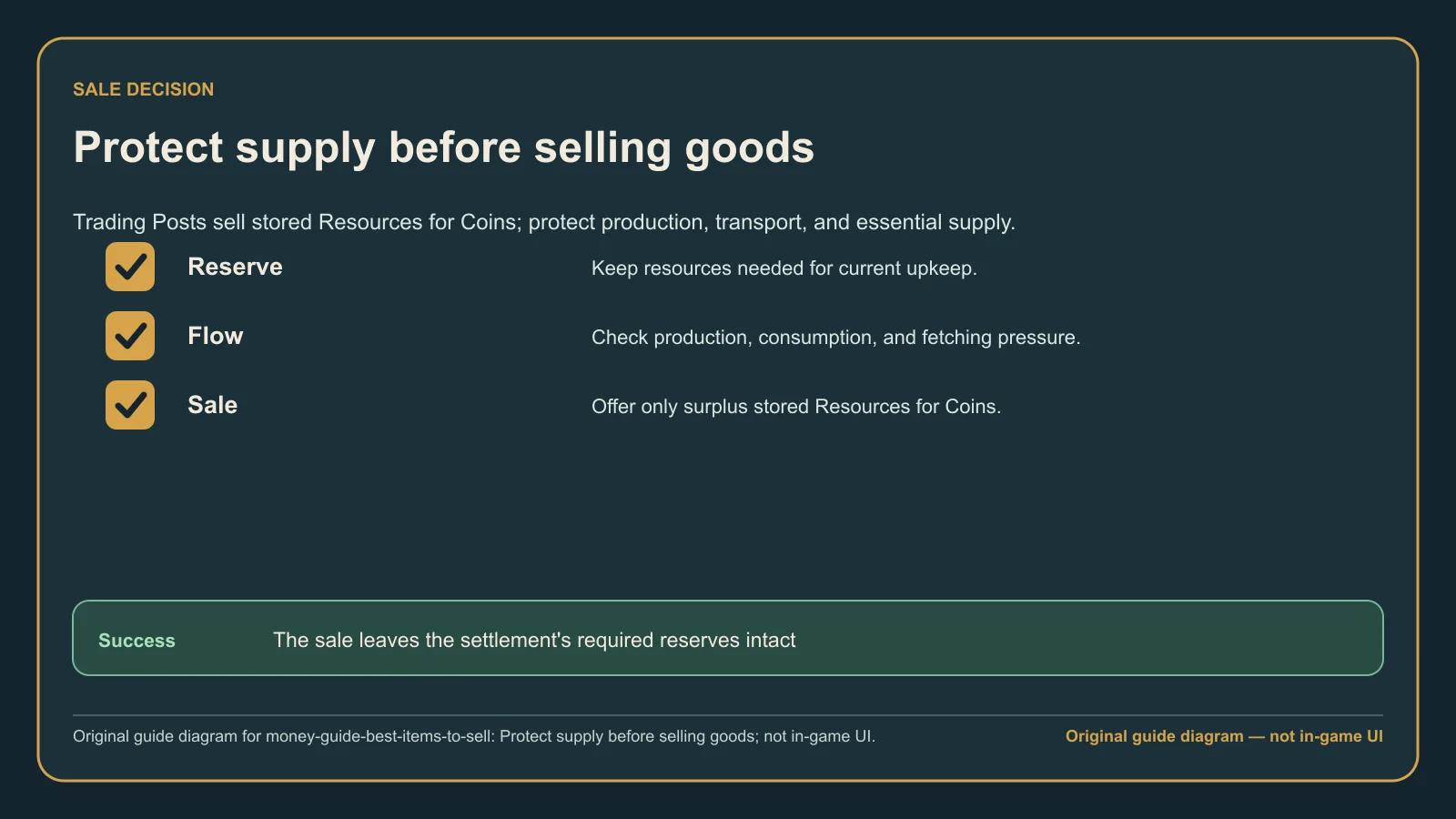
Original guide diagram — not in-game UI. A profitable sale starts with the resources the settlement cannot afford to lose.
Selling criteria: liquidity versus supply pressure
Before moving a stack into the sale queue, ask four questions:
- Is it liquid? The resource must be stored and saleable through the Trading Post under the current game version.
- Is it truly surplus? Protect the stock needed by current upkeep, production inputs, construction, and defenses.
- What is the route cost? A sale can pull goods through the same transport network serving essential production. Do not treat distance or handling as free just because the game has no simple route-cost number on this page.
- What is the opportunity cost? Selling an upkeep good can create a future shortage; assigning production and Fetchers to replace it also uses settlement capacity.
The current official Buildings documentation, checked August 31, 2026, is a single-source input for the transport side of this method: production routes need an assigned Fetcher, and poor routing can make essential supply harder to sustain. Treat that as version-sensitive guidance rather than a permanent balance rule.
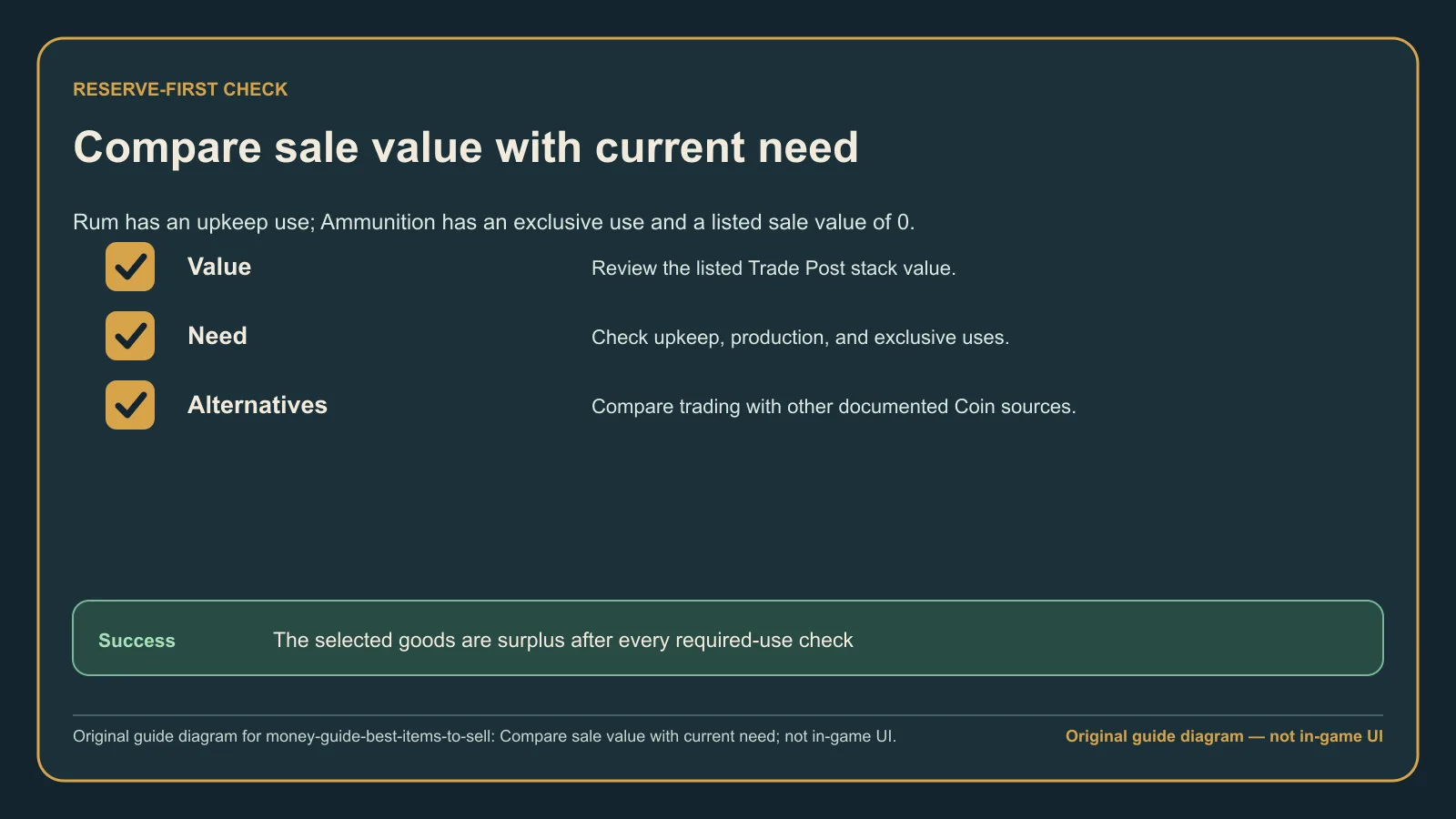
Original guide diagram — not in-game UI. The value column matters only after the reserve and required-use checks pass.
Selling choices by game stage
| Stage | What to sell | What to protect | Decision rule |
|---|---|---|---|
| Early | Small, repeatable surpluses already reaching storage | Food, upkeep, active construction inputs, and goods needed to keep the first chains moving | Choose liquidity and stability over the largest-looking stack |
| Mid | Surplus from a stable chain after current demand and transport are covered | Inputs shared by several chains and goods whose replacement route is already strained | Compare listed value with reserve safety and Fetcher pressure |
| Late | Deliberate overproduction whose required uses and replacement time are understood | Elite-crew upkeep, defense supply, rare inputs, and any bottleneck for the next fleet or settlement goal | Sell by the next strategic need, not by a permanent item tier list |
Two bounded item examples
The following examples come from individual official resource entries last checked August 31, 2026. They are useful filters, but they remain single-source and may change with balance updates:
- Rum: the current entry lists a Trade Post stack value of 22 and identifies Rum as Picaroons upkeep. Its value does not make it an automatic sale; protect the active upkeep reserve first.
- Ammunition: the current entry lists a Trade Post stack value of 0 and an exclusive use by Gun Tower buildings. Under that documented state, it fails both the value and required-use filters.
These examples explain why “highest value” is not enough. A safer candidate is a stored surplus with no immediate required use, a healthy replenishment route, and a sale value that serves the current Coin goal.
A repeatable money loop
- Define the Coin goal before selling anything.
- Check current demand and reserve each candidate resource needs.
- Inspect the production and Fetcher route that will replace the stack.
- Exclude zero-value, exclusive-use, and immediately required goods.
- Sell a small surplus, then recheck storage, delivery, and upkeep pressure.
- If supply becomes fragile, stop selling and repair the chain with the logistics guide.
The current official Coins entry alone lists trading, raiding, Wealth Events, Wealth Ship loot, and certain Crow's Nest Discovery Events as Coin sources. Because that list is version-sensitive and single-source here, use it only to compare alternatives visible in your current save; it does not establish one best income route.
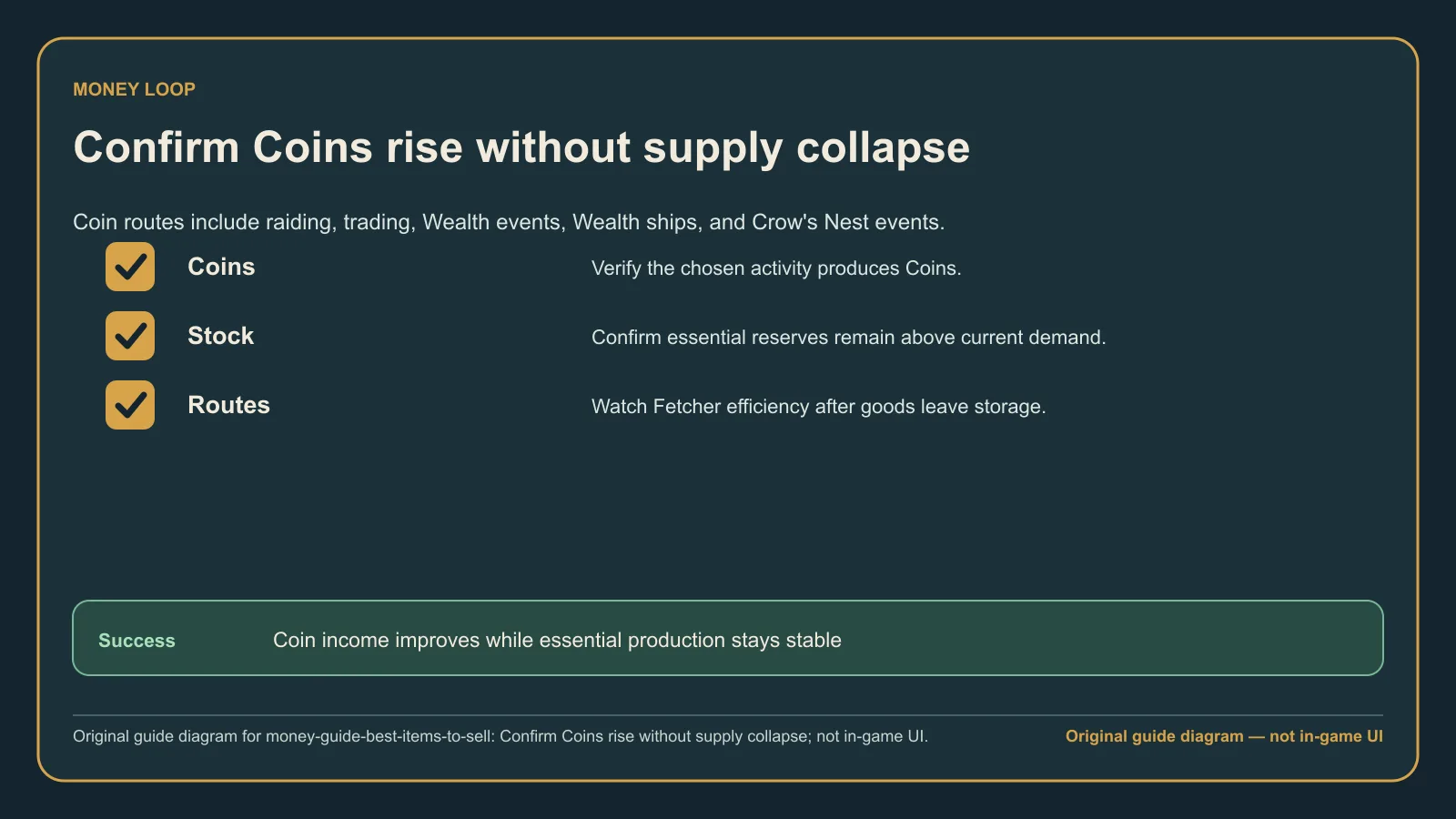
Original guide diagram — not in-game UI. The successful sale improves liquidity without turning the replacement route into the next emergency.
Common mistakes
- Selling the largest stack without checking why it accumulated or who consumes it.
- Treating a listed Trade Post value as profit after supply and handling pressure.
- Selling upkeep goods, then spending more time rebuilding the reserve than the Coins saved.
- Exporting from an unstable chain whose Fetcher route is already failing.
- Copying one permanent “best goods” list across early, mid, and late saves.
- Ignoring other Coin opportunities that may avoid draining the settlement stockpile.
FAQ: Frequently asked questions
What should I sell first in Corsair Cove?
Sell a small surplus that is already stored, has no immediate required use, and can be replaced without straining its route. The evidence does not support one first item for every save.
Is Rum always one of the best goods to sell?
No. Its current official entry lists a sale value, but also identifies an upkeep use. That single-source record is balance-sensitive, so reserve safety comes before its listed value.
Why did selling goods make my settlement worse?
The sold stack may have been an input, upkeep reserve, construction need, or part of a strained delivery route. Pause exports and use the production-chain guide and logistics guide to find the new bottleneck.
What to do next
- Set up the sale building with the Trading Post guide.
- Stabilize inputs and outputs with the production-chain guide.
- Fix long or overloaded delivery routes with the logistics guide.