Quick diagnosis
An empty workshop usually means one link in the chain is missing. The building needs a reachable source, the correct input in its storage, workers who can reach it, room for output, and a Fetcher or warehouse route that moves the product onward.
Open the production overview, default hotkey I, before changing the layout. Look for one building with full input storage and another with an empty input slot. That gap tells you where the chain stops.
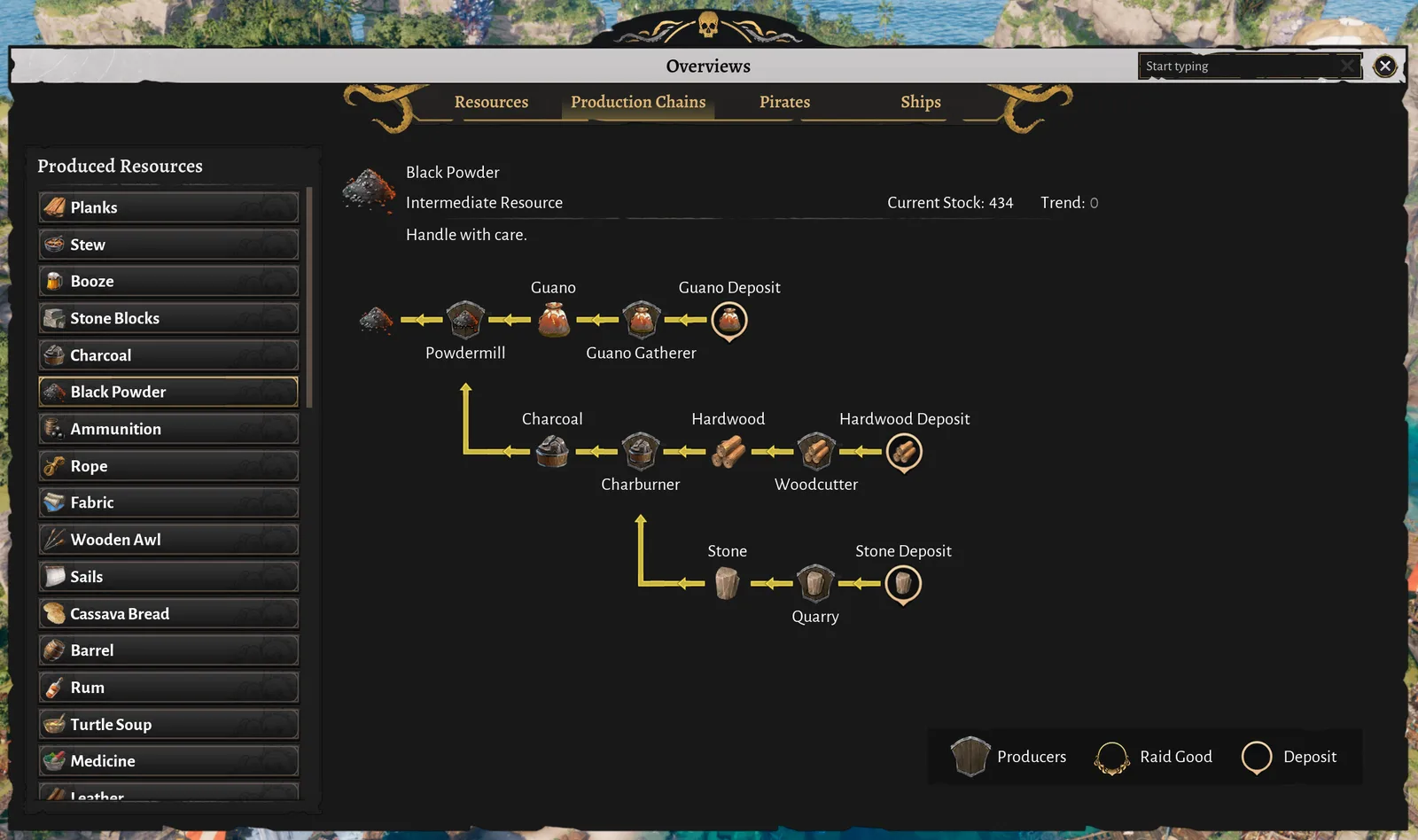
Official Corsair Cove wiki production-chain image showing the overview panel to open before changing an idle workshop.
Version and source notesUpdated 2026-08-26 · Source review due
- Updated
- 2026-08-26
- Works with
- Released PC version after Patch #4
- What this guide covers
- Covers workshop inputs, storage, recipes, and production bottlenecks
- Version notes
- Recipes, building costs, and balance may change after major patches
- Update status
- Source review due
Trace the recipe from deposit to destination
- Select the idle building and read its recipe, including every input and output.
- Find the raw deposit or prior producer that feeds it.
- Check whether the source has workers and visible stock of the correct item.
- Select the workshop input storage and make sure the incoming resource is not filtered out.
- Leave space in output storage, because a workshop can pause when finished goods have nowhere to go.
- Watch one full delivery cycle before adding duplicate buildings.
Early chains are short, but they quickly branch. The Sawmill turns 4 Hardwood into 10 Planks per minute, and those Planks feed the first Pier, ship, and many construction jobs. If no Fetchers move Planks out, the Sawmill can sit idle while workers still consume upkeep.
Fix the most common bottlenecks
Start with the symptom that creates an observable result:
- No raw material: connect or build the missing gatherer, then wait for stock to appear.
- Input never arrives: use the Fetcher route guide to inspect pickup stock, destination space, camp range, and route length.
- Output is full: add nearby warehouse space or connect a consumer that actually uses the product.
- Workers are missing: pause lower-priority jobs or recruit more Drifters before expanding the chain.
- Chain is too advanced: later resources such as Black Powder require several producers, deposit types, and Fertile Area, so do not force them into the first camp.
Build chains players actually need next
When choosing what to expand, follow the next visible obstacle:
- Planks and basic construction for the Pier and first ship.
- Food, drink, and everyday upkeep before opening many workplaces.
- Stone Blocks and mid-game materials when buildings demand them.
- Rope, Sails, and specialized goods when stronger ships and Trade Piers unlock.
This order matters because a workshop that produces something unused is not progress. It still uses workers, storage attention, and transport capacity.
If the required workshop or resource is not available yet, use the building and resource unlock guide to check the Compass, ship-tier, crew-demand, and production prerequisites before redesigning the chain.
Resource-specific production plans
Use these guides when you need a concrete recipe or supply calculation:
- Turtle Catcher and Soup Kitchen ratio: separate the crew unlock from water and Turtle supply.
- Eyepatch Maker requirements: check crew access, Leather, Fibre, and distribution.
- Salt and Saltern supply ratios: share one producer between ovens and tanners without double-counting capacity.
- Pearl Diver supply planning: compare jewellery and tailoring demand, then calculate net stockpile time.
Common mistakes
- Building two workshops before proving that one can receive inputs.
- Placing storage far from both producer and consumer.
- Ignoring red or long route lines until the whole camp slows down.
- Upgrading to a complex recipe before the camp can gather every prerequisite.
- Treating a full output warehouse as a worker shortage.
For larger settlements, use the logistics tips to turn separate chains into compact hubs. When expansion crosses the island, the second camp guide explains how to keep local production self-sufficient.
What success looks like
The source gathers material, a Fetcher delivers it, the workshop input rises, the finished output appears, and a connected warehouse or consumer clears the output before it backs up. If the chain runs for a short time and then stops, the next bottleneck is usually storage or transport, not the recipe itself.